
Beyond the echo chamber, Asian sisters bring mission stories to mainstream media
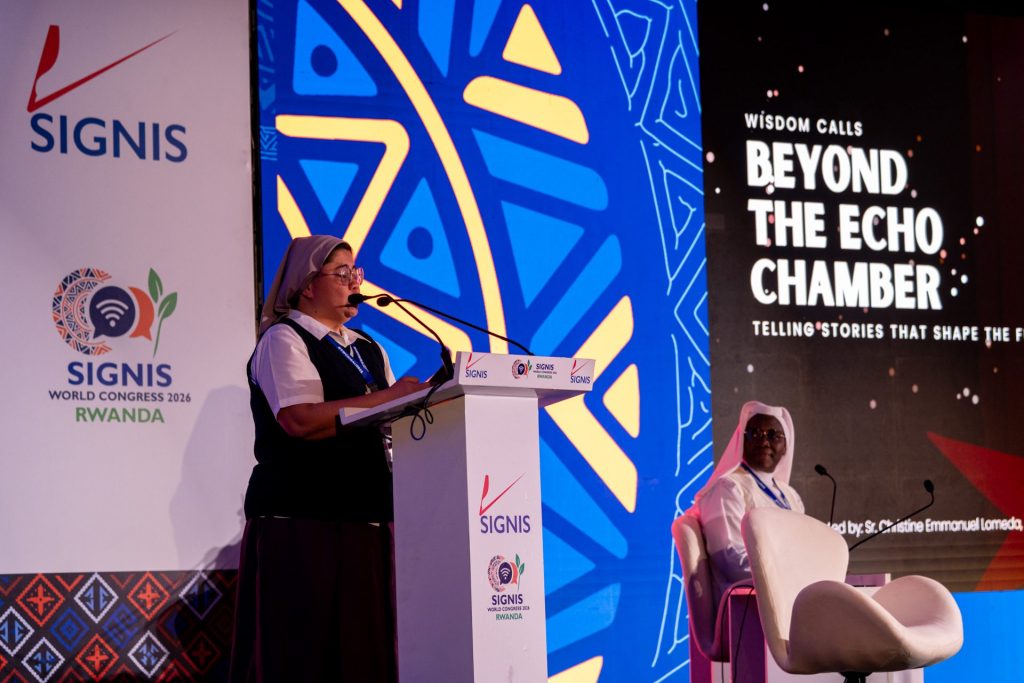
Sr. Christine Emmanuel Lomeda, ra, of the Philippines speaks during the Wisdom Calls session at the SIGNIS World Congress in Kigali, Rwanda. Lomeda urged religious sisters to bring stories from their ministries beyond Church circles and into the wider public conversation. Photo by Mark Saludes
Mark Saludes, Rwanda, August 10, 2026
Before taking the stage in Kigali, Sr. Siphim Xavier was traveling through places where the stories of displaced people rarely reached the wider public.
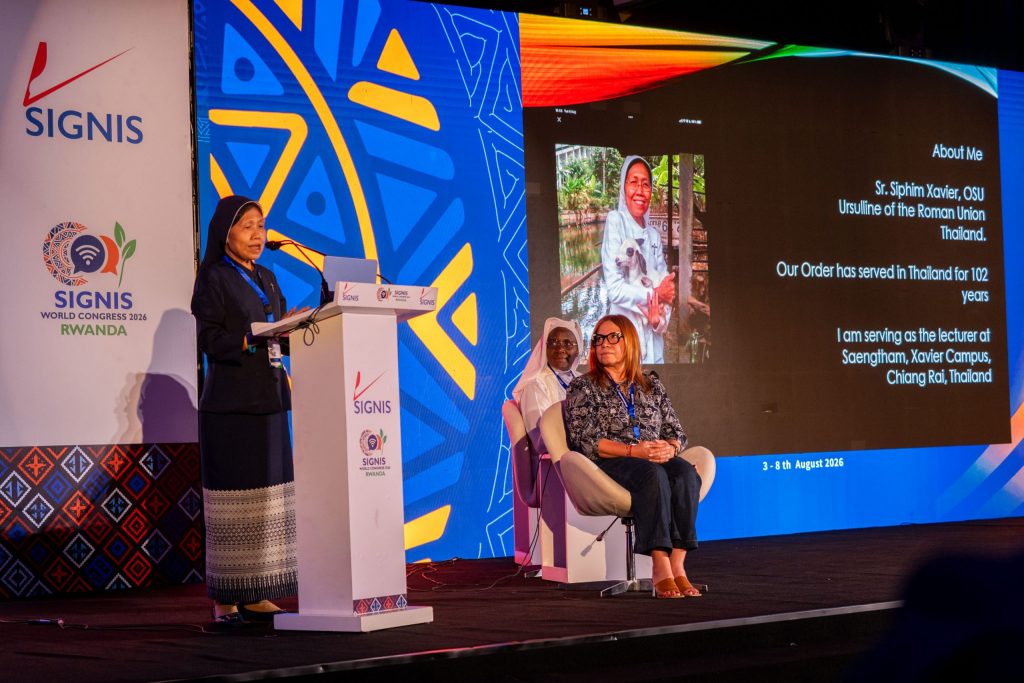
The Thai Ursuline sister showed images of boats on the Salawin River, difficult mountain routes, and communities along the Thai-Myanmar border. Her presentation described religious sisters bringing rice, blankets, medicine, milk, and other supplies to people displaced from their homes.
“Ready to go beyond our borders,” Xavier told participants at the SIGNIS World Congress in Rwanda on Aug. 7.
But Xavier and two other Asian religious women who spoke at the gathering were confronting another kind of border — the divide between stories known largely within Church circles and the wider public conversation.
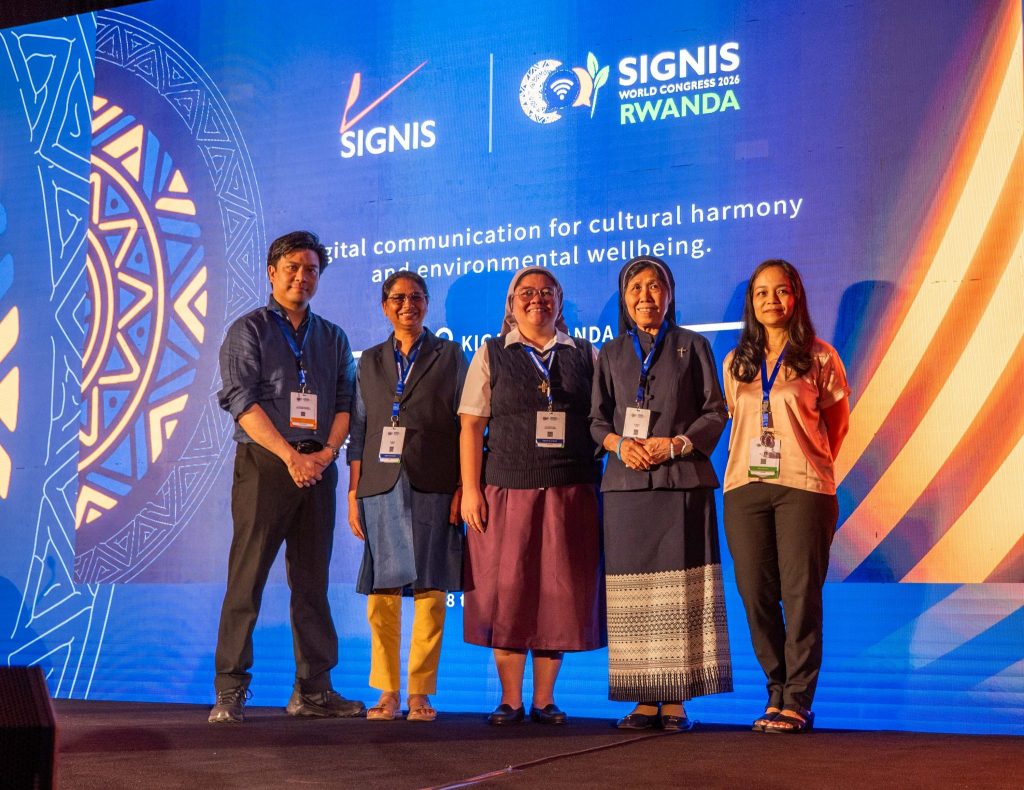
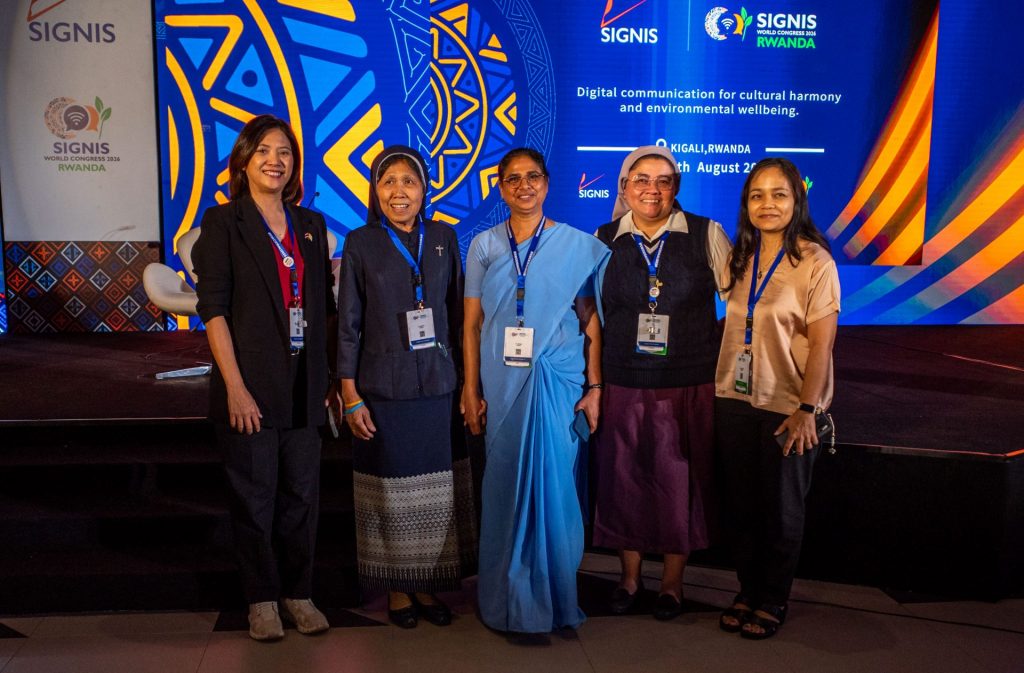
Xavier of Thailand, Sr. Ganga Rawat, SSpS, of India, and Sr. Christine Emmanuel Lomeda of the Religious of the Assumption in the Philippines took part in the Wisdom Calls program, a SIGNIS-led initiative.
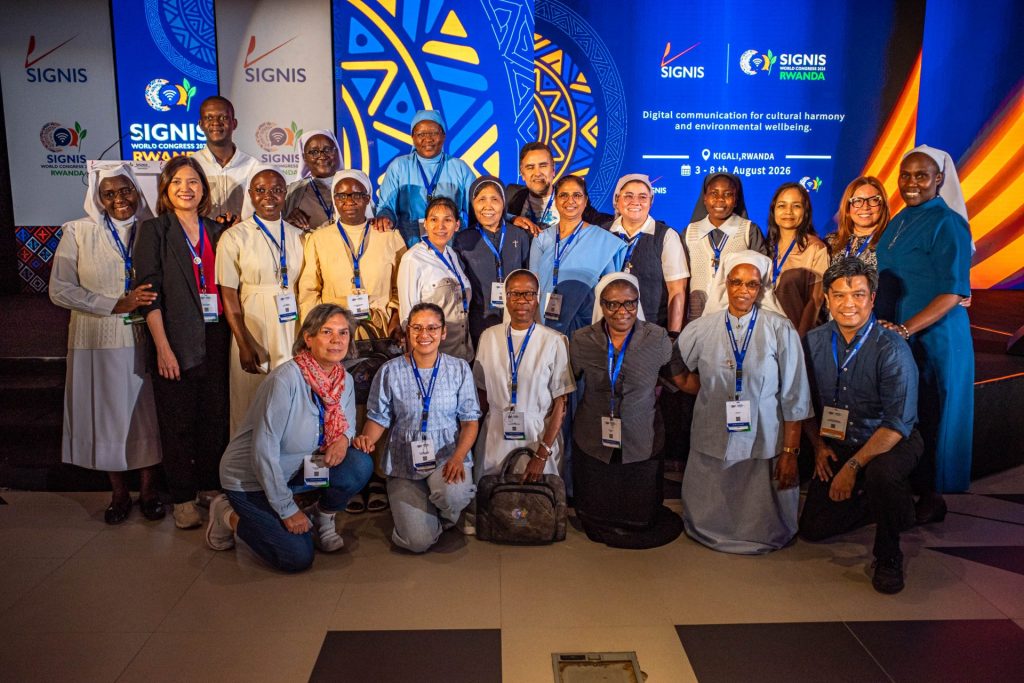
The two-year program, supported by a $300,000 grant from the Conrad N. Hilton Foundation, brings together 34 women religious from Africa, Asia, and Latin America with Catholic communicators working in secular and Church media.
It aims to strengthen the sisters’ communication skills and build long-term relationships with media professionals.
For the three Asian sisters, the question was how to get their stories out.
Stories few people hear
Lomeda pointed to an experience at a school in the Philippines as one example of a story that rarely reaches audiences beyond Church circles.
“Imagine your school has just installed another CCTV camera. Another security guard stands at the gate. Another set of rules is posted on the wall,” she told participants.
“Will children be safer? Perhaps. But only for today. What protects them tomorrow?” she added.
The Filipino sister described the experience of St. Rita Academy, an Assumption school in the central Philippines, against the backdrop of school violence involving young people in the country.
Rather than rely only on tighter security, she said the school formed teachers, parents, staff, and students to become advocates of dialogue, respect, nonviolence, and human dignity.
The congregation believes that “the strongest security system is not always standing at the entrance. Sometimes, it is the conscience of the person walking through it,” Lomeda said.
Then she turned to a different problem. “Almost nobody hears stories like this,” she said.
Lomeda said such accounts often remain in Catholic publications and institutional social media.
“We keep telling our stories — but mostly to people who already know them. That is an echo chamber,” she said.
She said bringing such stories into wider public conversation requires relationships with journalists, filmmakers, digital creators, and others working in media, rather than simply producing more content for Church audiences.
Sr. Nina Krapić, deputy director of the Holy See Press Office at the Dicastery for Communication, raised the same concern during the congress a day earlier.
“The margins are not somewhere far away. They are in the center of the life of every Catholic sister,” Krapić said, referring to sisters working in hospitals, schools, universities, urban slums, and remote villages and accompanying migrants, refugees, and other vulnerable communities.
She said communicating those lived realities should not be considered secondary to the sisters’ mission.
Going back to her roots
For Lomeda, the Asian edition of Wisdom Calls in Bangkok in May also brought her back to an earlier part of her life.
Before entering religious life, she worked as a journalist in the Philippines. After the workshop, she contacted former colleagues, pitched a story from her ministry, and invited them to consider its significance beyond the Church.
“So I went back to my roots,” she told the Kigali gathering.
“Because if we truly believe our stories can transform lives, then we must have the courage to bring them into the public square, where they can inspire not only fellow believers, but society as a whole,” Lomeda said.
Dr. Peter Monthienvichienchai, secretary-general of SIGNIS, said religious sisters are often “underrepresented, misrepresented and, in the worst case, malrepresented,” particularly in Western media.
He said he hoped their stories could receive space on morning television and evening news programs “with just as much importance as some billionaire making some statements.”
Learning how journalism works
For Xavier, engagement with mainstream journalism is not entirely unfamiliar.
The Thai sister belongs to the Ursulines of the Roman Union and teaches at Saengtham College’s Xavier Campus in Chiang Rai. Before entering religious life, she worked for The Associated Press in Bangkok.
At the Wisdom Calls meeting in Bangkok, Xavier said participants learned techniques for dealing with the press while meeting sisters serving in different parts of Asia.
Her presentation in Kigali included images of journeys along the Thai-Myanmar border and assistance brought to communities in need. One showed a sister handing a blanket to an elderly woman. Another described bringing “prayers and medicine to people in need.”
After the Bangkok gathering, Xavier wrote an article about the program for a Catholic newspaper and remained in contact with a Reuters journalist she met during one of the sessions.
Their conversations included a crucial principle of reporting from vulnerable communities: protecting sources.
“He advised me how to protect the source — safety of the sources is very important for news agency,” Xavier said.
The lesson underscored the risks that can come with greater visibility when sisters work among people affected by conflict, displacement, poverty, and other forms of vulnerability.
Krapić said the Vatican-led Pentecost Project similarly trains sisters in journalism and participatory storytelling, including ways of allowing marginalized people greater control over how their experiences are portrayed.
For Xavier, another barrier comes from a tradition in religious life of doing good without calling attention to oneself.
Her presentation acknowledged that instinct, but she also said sisters need to move beyond familiar boundaries because others can draw inspiration from witnessing the work being done.
Sr. Jane Wakahiu, associate vice president for program operations and head of Catholic Sisters at the Conrad N. Hilton Foundation, addressed that tension during the congress.
“This is why I often say that humility should never become invisibility,” she said. “Yet when their stories remain untold, the public square becomes poorer.”
‘Our mission deserves to have a voice’
Rawat brought the lessons from Bangkok back to India.
A member of the Missionary Sisters Servants of the Holy Spirit, she said Wisdom Calls brought together religious women from different congregations serving in education, health care, social work, pastoral care, communication, and other ministries.
“Our mission deserves to have a voice,” Rawat said. She said the work of religious sisters “often transforms lives quietly and faithfully, yet many of these stories remain untold.”
For Rawat, making such work visible was not about seeking recognition, but about sharing hope and allowing people outside their communities to encounter the realities sisters witness through their ministries.
After returning from Bangkok, she published a write-up about the seminar and organized a one-day program for young sisters from different congregations in Indore, where she shared what she had learned and encouraged them to see communication as part of their mission.
“Their enthusiasm and participation reminded me that when we share what we learn, the impact multiplies,” Rawat said.
Her follow-up showed how the training could extend beyond the sisters who attended the original gathering.
The experiences of Xavier, Rawat, and Lomeda converged on a simple challenge: being close to stories from the margins is not enough if those stories never reach the wider public.
For Lomeda, the effect of telling them can take different forms.
“A teacher remembers why she entered the classroom. A journalist discovers a story worth telling. A young person begins to believe that peace is still possible,” she said.
“And perhaps a young woman, reading that story, begins to wonder if a life of service and faith could one day become her own,” she said.
She ended with the same problem she had identified earlier — stories circulating only among people who already know them.
“If our stories can awaken that possibility,” Lomeda said, “then perhaps they were never meant to remain inside the echo chamber.”
Published in: https://www.licas.news/2026/08/10/beyond-the-echo-chamber-asian-sisters-bring-mission-stories-to-mainstream-media/